
Trolls & Giants of Iceland
Petrified sea stacks, fearsome giantesses, and the 13 Yule Lads of Christmas
Trolls in Icelandic Folklore
In Icelandic folklore, trolls are enormous, ugly, and dim-witted creatures that live in the mountains and caves of the island's remote interior. Unlike their cousins the Norse jotnar, the primordial giants of Old Norse mythology who could be wise, cunning, and even beautiful, Icelandic trolls are firmly rooted in the landscape itself. They are creatures of rock and earth, immensely strong but slow of mind, and they share one fatal weakness: sunlight turns them to stone.
This vulnerability to sunlight is the defining characteristic of Icelandic trolls and the key to understanding the landscape legends that surround them. Every unusual rock formation, every isolated sea stack, every strangely shaped boulder in Iceland is potentially a petrified troll, caught out by the dawn after a night of mischief.
While Norse jotnar like Ymir, Surtr, and Skaoi are cosmic figures who shaped the world and interacted with the gods, Icelandic trolls are more local and personal. They steal livestock, kidnap people, and guard hidden treasure. They are dangerous but not invincible, and clever humans can outwit them by keeping them talking until sunrise. This blend of danger and comedy runs through hundreds of Icelandic folk tales, making troll stories some of the most entertaining and enduring narratives in the country's oral tradition.
Key Facts
- —Turn to stone in sunlight
- —Live in mountains and caves
- —Enormous strength
- —Dim-witted but dangerous
- —Emerge only after dark
- —Can be outwitted by clever humans
Famous Trolls
- —Gryla — fearsome child-eating giantess
- —Leppalui — Gryla's lazy husband
- —The Reynisdrangar trolls — petrified at sea
- —Hvitserkur troll — turned to stone while drinking
- —The 13 Yule Lads — Gryla's mischievous sons
Reynisdrangar — Trolls Turned to Stone
Rising dramatically from the churning North Atlantic just off the coast of Reynisfjara, the Reynisdrangar are basalt sea stacks that reach up to 66 meters above the waves. They are among Iceland's most photographed natural landmarks, and the legend behind them is one of the country's most beloved troll tales.
According to the old story, two trolls were out one night attempting to drag a three-masted ship ashore. They waded into the sea, grasping at the vessel and hauling it toward the black sand beach. But they were so absorbed in their task that they failed to notice the sky brightening along the eastern horizon. When the first rays of dawn broke over the mountains, the trolls were caught in the open, far from any cave or shelter. The sunlight struck them instantly, and they were turned to stone where they stood, frozen forever in the surf alongside the ship they had been trying to capture.
Today the Reynisdrangar stacks stand as a dramatic silhouette against the sky, visible from the famous Reynisfjara black sand beach. The stacks are a nesting site for puffins, fulmars, and guillemots. The surrounding area, with its geometric basalt columns and roaring waves, is consistently ranked among the most beautiful non-tropical beaches in the world.
Safety Warning — Sneaker Waves
Reynisfjara is one of the most dangerous beaches in Iceland. Powerful sneaker waves can surge far up the beach without warning, and several visitors have been killed or seriously injured. Never turn your back on the ocean. Stay well back from the waterline and watch the wave patterns carefully before approaching the shore.

Reynisdrangar sea stacks — said to be trolls turned to stone by the dawn

The stacks as seen from the beach
Hvitserkur — The Drinking Troll
On the eastern shore of the Vatnsnes peninsula in Northwest Iceland, a 15-meter basalt sea stack rises from the shallows like a creature frozen in the act of drinking from the sea. This is Hvitserkur, one of Iceland's most striking natural formations, and the subject of one of the country's most vivid troll legends.
The story tells of a troll from the Strandir coast who harbored a deep hatred for the Christian monastery at Thingeyraklaustur. One night the troll set out to destroy the monastery, wading across the bay. But the troll underestimated the distance, and when the sun rose over the eastern mountains, the troll was caught in the open water. The sunlight turned it to stone instantly, and there it has stood ever since, bent over the water in a posture that looks remarkably like a creature drinking.
Hvitserkur's unusual shape has inspired many comparisons — some see a drinking rhinoceros, others an elephant, and still others a dragon. The base of the stack has been reinforced with concrete to prevent erosion. The site is accessible via a gravel road from Route 711 on the Vatnsnes peninsula, and a steep path leads down to the beach where Hvitserkur can be viewed at close range.
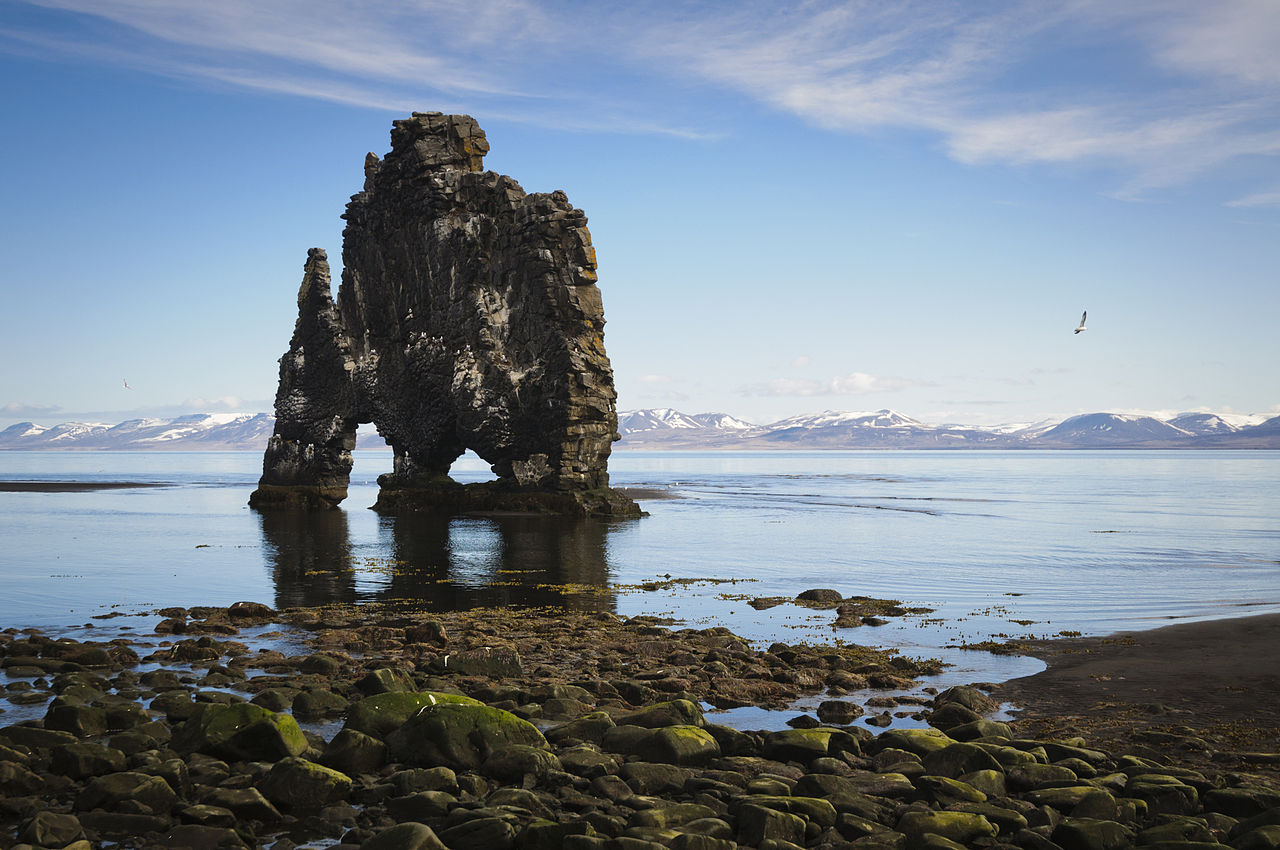
Hvitserkur, the 15-meter petrified troll on the Vatnsnes peninsula
Dimmuborgir — The Dark Castles
Near the shores of Lake Myvatn in Northeast Iceland lies one of the country's most otherworldly landscapes: Dimmuborgir, the "Dark Castles." This vast field of dramatic lava formations resembles a ruined city of dark towers, arches, and caves, and it has been associated with trolls and supernatural beings for as long as anyone can remember.
Dimmuborgir was formed approximately 2,300 years ago when a massive lava flow poured over a small lake. The water beneath the lava boiled violently, sending columns of steam upward through the molten rock. As the lava cooled, these steam vents created the pillars, arches, and hollow chambers that give Dimmuborgir its extraordinary appearance. When the still-liquid lava drained away, it left behind the solidified formations that stand today — an accidental architecture that looks eerily intentional.
In Icelandic folklore, Dimmuborgir is said to be the homeland of Gryla and Leppalui, the troll parents of the 13 Yule Lads. During the holiday season, the Yule Lads are said to descend from Dimmuborgir one by one to visit the towns below. Several well-marked walking trails wind through the formations. The most famous formation is Kirkjan ("The Church"), a large cave with a remarkably cathedral-like interior.

The towering lava pillars of Dimmuborgir, said to be home to trolls

Walking trails wind through the Dark Castles
Gryla & The 13 Yule Lads
No figure in Icelandic folklore is more terrifying than Gryla, the fearsome giantess who lives in the mountains with her third husband, the lazy troll Leppalui, and her 13 sons, the Jolasveinar or Yule Lads. Gryla is an ancient figure in Icelandic tradition, first mentioned in the 13th-century Prose Edda, and she has been frightening Icelandic children into good behavior for over 800 years.
According to legend, Gryla descends from the mountains before Christmas to search for misbehaving children, whom she snatches up and carries back to her cave in a sack. There, she boils them in her enormous cauldron and devours them. She is so terrifying that in 1746, a public decree was issued prohibiting parents from using Gryla to frighten their children.
Gryla's 13 sons are the Jolasveinar, the Yule Lads, who descend from the mountains one by one during the 13 days before Christmas. Each has a distinct name and personality based on the particular prank or mischief he specializes in. Children place a shoe in the window each night; well-behaved children find a small gift in their shoe the next morning, while naughty ones receive a rotten potato.
Days 1–5 (Dec 12–16)
- Stekkjastaur
Sheep-Cote Clod — harasses sheep, stiff peg-legs - Giljagaur
Gully Gawk — hides in gullies, steals cow milk - Stufur
Stubby — abnormally short, steals pans to eat crusts - Thvorusleikir
Spoon-Licker — steals and licks wooden spoons - Pottaskefill
Pot-Scraper — steals leftovers from pots
Days 6–9 (Dec 17–20)
- Askasleikir
Bowl-Licker — hides under beds, steals bowls - Hurdaskellir
Door-Slammer — slams doors at night - Skyrgamur
Skyr-Gobbler — devours all the skyr - Bjugnakraekir
Sausage-Swiper — steals smoked sausages from rafters
Days 10–13 (Dec 21–24)
- Gluggagaegir
Window-Peeper — peers through windows to find things to steal - Gattathefur
Doorway-Sniffer — has an enormous nose, sniffs out laufabraud - Ketkrokur
Meat-Hook — uses a hook to steal smoked meat - Kertasnikir
Candle-Stealer — steals candles, once children's only light source
The Yule Cat (Jolakotturinn)
Accompanying the Yule Lads is the Jolakotturinn, the Yule Cat, a monstrous feline that prowls the countryside during Christmas. The Yule Cat is said to eat anyone who has not received new clothes before Christmas Eve. This legend served a practical purpose: it motivated farm workers to finish processing the autumn wool before the holiday, as those who worked hard would receive new clothing as a reward, while the lazy would be left to the mercy of the cat.
Trollaskagi — The Troll Peninsula
Between the fishing towns of Siglufjorur and Dalvik in North Iceland stretches one of the country's most dramatic and legend-rich landscapes: Trollaskagi, the Troll Peninsula. Its name alone tells you what the old Icelanders thought of this wild, mountainous region — a place so rugged and imposing that it could only be the domain of trolls.
Trollaskagi is defined by its towering peaks, many exceeding 1,000 meters, deep glacially carved valleys, and dramatic fjords that cut into the coastline. The peninsula separates the Skagafjorur and Eyjafjorur districts, and for centuries it was one of the most isolated regions in northern Iceland. Before the Hedinsfjorur tunnel was opened in 2010, connecting Siglufjorur to the rest of the north, travelers had to navigate a treacherous mountain road that was frequently impassable in winter.
The folklore of Trollaskagi is rich with stories of trolls inhabiting the mountain peaks and descending into the valleys to cause mischief. Today, Trollaskagi is popular for backcountry skiing in winter and hiking in summer, and the dramatic coastal road around the peninsula (Route 76) is considered one of the most scenic drives in Iceland.